Saturday, December 06, 2014

Coleridge and the Daemonic Imagination - reviewed in The Year's Work in English Studies


Reviews can take some time to filter through in academe: even though Coleridge and the Daemonic Imagination was published three years ago, I'm posting one here that only came to my notice recently. It's from The Year's Work in English Studies 92 (2013) - a very useful guide to the latest scholarship (published by Oxford University Press):

'Gregory Leadbetter's Coleridge and the Daemonic Imagination offers a fascinating and compelling new reading of Coleridge's thought, with a particular emphasis on his poetry. His argument builds from a notebook entry which worries over the daemonic experiences Coleridge had. These were experiences of the "transnatural": that which permits the mind to foray into a world denied by traditional social and religious codes. The transnatural, Coleridge discovers, comes from within as a form of willed transition that permits an encounter with, simultaneously, shame and power. It is, for Leadbetter, a dilemma central to "the drama of human becoming" (p. 3). The openness of this position allows Leadbetter to offer us a Coleridge far more fluid in his religious and philosophical thinking than is common. Indeed, poetry and poetic possibility move to the centre of his thought: "Coleridge remained constitutionally open to experiences beyond his deliberate control" (p. 14). Leadbetter focuses especially on the 1790s and on Coleridge's three great poetic myths of daemonic imagination - Kubla Khan, The Rime of the Ancient Mariner, and Christabel - but he also, pleasingly, encourages us to see this openness right across the span of Coleridge's career. The book offers startling reconsiderations of Coleridge's Unitarianism, his politics, and his relationship with Wordsworth. Wordsworth, for Leadbetter, recognized the same dilemmas, but was wary of Coleridge's freedom: nature becomes a "moral and epistemological norm" (p. 39) that Wordsworth clings to but Coleridge transgresses. The combination of activity and passivity in the daemonic makes clear the link with the Coleridgean imagination. Language is itself a "transnatural" agent in Kubla Khan's "self-risking poetics" (p. 185). The usual reading of Christabel has Christabel as innocent and opposed to the evil Geraldine. But just as the Ancient Mariner is a "transgressor without being evil" (p. 182), so Leadbetter finds in Christabel Coleridge exploring the possibility that the union with Geraldine, however troubling, was "an act and expression of [Christabel's] own spirit" (p. 203). Leadbetter writes fluidly and clearly, but his style also bristles with excitement. This is a thoughtful, imaginative, and often daring new account of the poet.'


Friday, September 19, 2014

Appearing at the Birmingham Literature Festival...


It's nearly October - which means that the excellent Birmingham Literature Festival is nearly with us (2-11 October 2014).

As ever, there are many mouthwatering events to attend, as you'll see from a glance through the programme - but I feel it's only right that I should draw your attention to two events with which I'm personally involved...

The first is Voices in Fiction, 7.30-8.45pm on Friday 3 October, where I have the pleasure of chairing a discussion with four fine writers: Kerry Hudson, Sathnam Sanghera, Lottie Moggach and Nikesh Shukla, each of whom will be reading from and speaking about their latest novels - and the art of fiction today.

The second is Soap City, 6-7pm on Friday 10 October, where this time I'll be joining a panel, chaired by the wonderful Helen Cross - also a Fellow of the Institute of Creative and Critical Writing at Birmingham City University - to discuss just what it is that has made Birmingham and the Midlands home to such a striking tradition of soap opera. We'll also be talking about what it's like to work on continuing series in television and radio. Mary Cutler will be representing The Archers and Crossroads; Tim Stimpson The Archers and Ambridge Extra; Claire Bennett Doctors - and I'll be recalling my time on Silver Street.

Just follow the links to book.

I hope to see you there...


Saturday, September 06, 2014

Doctor Who: Writing the Companions


Steven Moffat has come in for a lot of criticism since taking charge of Doctor Who – somewhat bafflingly, to my mind – but I’ve always admired his scriptwriting and I still do. Less given to sentimentality than Russell T. Davies, he has led the series with humour, verve and intelligence. The plots get a bit convoluted sometimes, but there are worse sins. Matt Smith did a fine job as the previous Doctor, but the excellent Peter Capaldi is – quite rightly – bringing a new edge to the role. Moffat’s priorities look good to me.

But – since its re-launch in 2005, the writing for Doctor Who has regularly gone wrong in one significant way: its handling of the companions.

After two episodes of Series 8, Danny Pink looks good, and I’m rather hoping that Journey Blue will not be abandoned by the Doctor after all. But Clara – ah, Clara…

Leaving aside the deeply misguided storyline in which the Doctor supposedly fell in love with Rose Tyler, (Davies, no!) the companions have too often been drained of their wonder at the Doctor's universe and installed with a whiny species of self-satisfied insolence, as if untouched by any sense of the mysteries they have been shown. They stay too much their same old selves, in the most extraordinary circumstances. To me, that's also unrealistic, in a damaging sense (and before anyone says, ‘Realistic? This is sci-fi!’ I would say that sci-fi especially demands psychological authenticity if it is to achieve narrative authenticity).

Dispiritingly, I suspect that this is because the writers intuitively perceive the offspring of contemporary society to be self-obsessed, lacking in humility and apparently incapable of having respect for anything they don't or can't be bothered to understand – and then write the characters accordingly. I have an awful feeling (oh say it ain’t so) that they are trying to write ‘normal’ characters, to which we, as members of that benighted society, can ‘relate’.

Don't do that. Neither children nor adults need it.

Clara has been a lost opportunity in this respect, because she was far and away the most promising companion since the re-launch. In effect, when they picked which Clara Oswald to settle on, they picked the wrong one. Her first incarnations were much more interesting: she was intelligent, with a mystery of her own. Now, despite her charms, of which there are many for sure, this ‘teacher’-variant is too often just another human arrogant enough to hold on to her seemingly uninterested attitude – long after the Doctor, I reckon, would have lost patience with it.

The Silurian Vastra, played by the wonderful Neve McIntosh, is a lively addition to the Whoniverse – as is/was the not-quite-human River Song: both Moffat creations.


For the Doctor’s regular companion(s), can’t we have more interesting humans, too? 

Sunday, August 10, 2014

CAST: The Poetry Business Book of New Contemporary Poets


A new book slips quietly into the world...

I'm delighted to have five poems in this excellent new anthology from Smith/Doorstop, which is edited by Simon Armitage, Joanna Gavins, Ann Sansom and Peter Sansom. Those poems include a mixture of published and unpublished work: 'Feather', 'The Body in the Well', 'The Chase', '6 June 1944' and 'Mouse'.

In the words of the Poetry Business website, it contains 'thirty-two of the brightest writing talents in one brilliantly-curated anthology', comprising a 'stimulating and hugely enjoyable survey of where poetry is now (or will be very soon)'. It's a pleasure to feature alongside Liz Berry, Niall Campbell, Kim Moore and the other fine poets in this book.

As soon as my own copy arrived, my next-door neighbour borrowed it and, as I haven't had it back yet, I think it's passed the pleasure test...

It is available now, but look out for launch events in due course.


Saturday, June 21, 2014

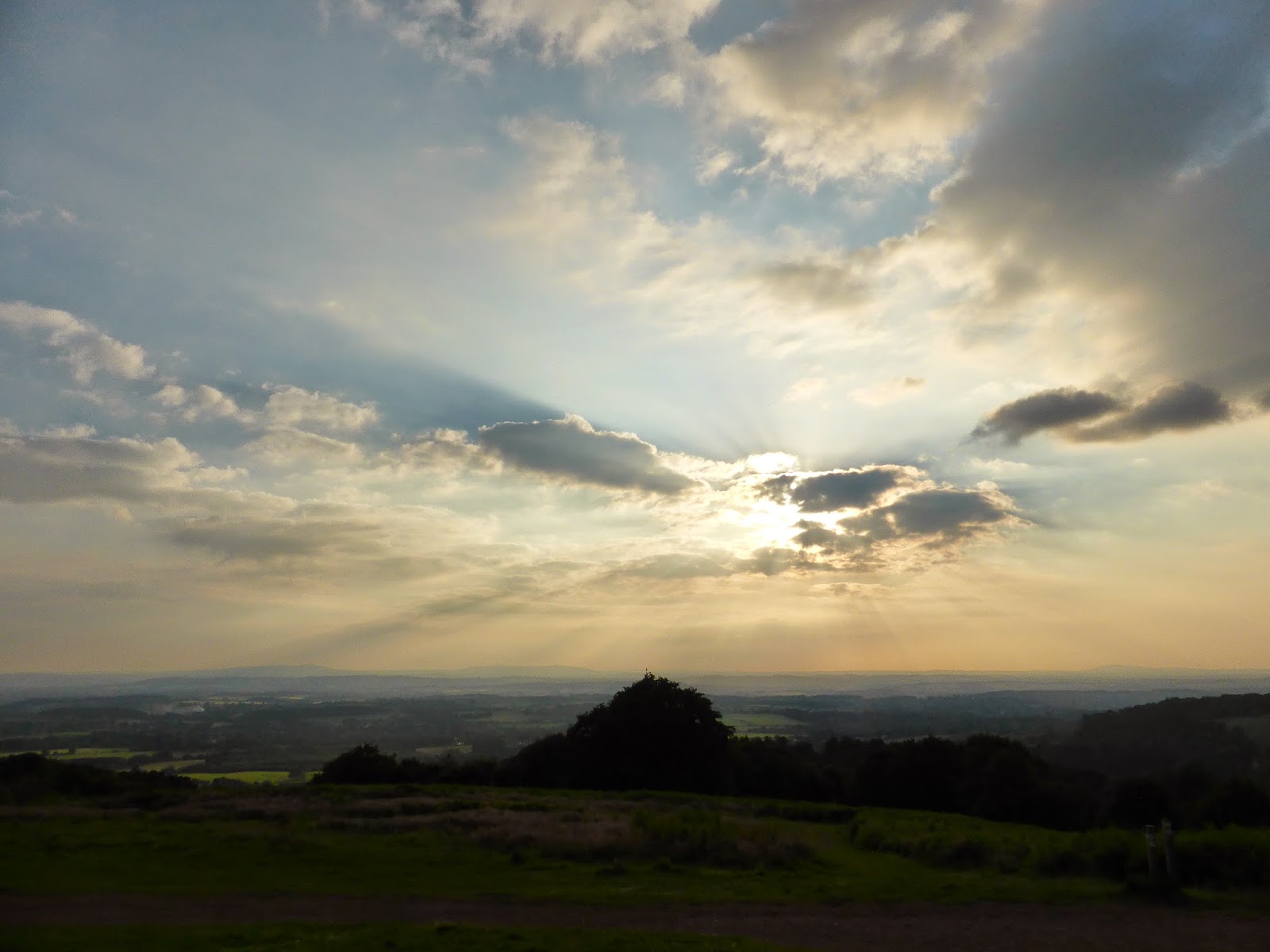
Poem: 'Midsummer at Clent'


This poem was written a few years ago, after watching the sun go down on the summer solstice at Clent (pictured above, today). It was published in my pamphlet The Body in the Well (HappenStance, 2007).


Midsummer at Clent

The year was bleeding across the sky
and we were there, perhaps, to celebrate.
I had no voice to give, nothing left
to say anything close to the truth until
I saw the kestrel nailed to the air,
aimed at the sun, holding her zenith
taut on the giddy fulcrum of the earth.
Held up like a lens to a blinding eye,
her feathers suspended in amber.
She stayed near me, as if she were
a periscope over the false horizon.
She stayed until the breath of winter
blew out of the western grave,
freezing a word on the lips of my praise.


Friday, June 20, 2014

'Twice Upon a Time: Magic, Alchemy & the Transubstantiation of the Senses', 26-27 June 2014, School of Art, Birmingham City University

Twice Upon a Time: Magic, Alchemy and the transubstantiation of the Senses


I'm delighted to be 'poet in residence' at this fascinating conference, taking place 26-27 June 2014 at the School of Art, Margaret Street, Birmingham. 

It is hosted by my colleagues at the Centre for Fine Art Research, the School of Art, Birmingham City University.

I'll be reading a selection of my poems that touch upon the conference's themes, across several of Thursday's panels.

I can only be there on the Thursday - but Friday has a full schedule of papers too.

It promises to be a stimulating event...

Wednesday, April 09, 2014

Wenlock Poetry Festival, 25-27 April 2014


It's a great pleasure to be reading at Wenlock Poetry Festival this year, where at 5.30pm on Saturday 26 April I'll be sharing the stand with David Morley (a happy reprise of our reading in Birmingham last October - but with some different poems...). You can purchase tickets for the event here.
 
We'll be reading outdoors, too - at Wenlock Priory (pictured above) - with two other writers chosen from among the participants in the Outdoors Writing Workshop that David will be running that morning (also at the Priory), which is sponsored by the Institute of Creative and Critical Writing, Birmingham City University.
 
The whole Festival will, as ever, be one of Britain's foremost celebrations of poetry. I'll be there all weekend.


Sunday, March 23, 2014

Beats and Birmingham: Poets and the City, 5.30pm, Friday 28 March 2014, Cafe Mezzanine, Library of Birmingham

presents

Beats and Birmingham: Poets and the City – feat. Bohdan Piasecki, Luke Kennard and others – with music from The Beat Generation Cut-up & Fold-in


JOIN US AT

Café Mezzanine, Library of Birmingham

5.30pm, Friday 28 March 2014


The Institute of Creative and Critical Writing warmly invite you to join us
for a blast of poetry and music – part of the Frontiers+ Festival 2014.

Bringing together the Beats, Birmingham and the poetry of city life, it will feature
poetry from Bohdan Piasecki and Luke Kennard, with Roy McFarlane (Birmingham
Poet Laureate 2010-11), Derek Littlewood, James Horrocks and Ben Titmus – performing both their own work and that of LeRoi Jones, Jackson Mac Low,
Lawrence Ferlinghetti, and poets of Birmingham Louis MacNeice and Roy Fisher.

There will also be music from Simon King, Sid Peacock and Steve Tromans,
performing their new settings of Beat legends Kerouac, Ginsberg, Burroughs
and Corso.

This event is FREE – no need to book.

I'll be hosting - and reading a little too.

We look forward to seeing you there…
 

Thursday, February 13, 2014

'Break, Blowe, Burn and Make Me New': John Donne and Benjamin Britten - Words into Music


You are warmly invited to join us for this special event next week, hosted by the Birmingham Conservatoire in collaboration with the Institute of Creative and Critical Writing, School of English:
 
'Break, Blowe, Burn and Make Me New': John Donne and Benjamin Britten - Words into Music
 
Venue:
Recital Hall, Birmingham Conservatoire
Price:
£6.50 (£4 concessions)
Date:
18 Feb 2014 (7:30pm)
Booking Information
Tickets available on the door

James Geer tenor
Ronald Woodley piano
Kate Kennedy, David Roberts and Gregory Leadbetter speakers
 
Benjamin Britten The Holy Sonnets of John Donne, Op.35
 
Benjamin Britten’s settings of nine of the Holy Sonnets of John Donne are some of the most intense, thoughtful, and at times disturbing of all his songs. They were composed in the summer of 1945 in the immediate aftermath of visits to the newly liberated concentration camps while he was on tour in Germany with Yehudi Menuhin. This evening’s event in music, words and images will explore these profound works from the perspectives of poetry, interpretation, musical setting, and the composer’s life, with contributions from Britten literary specialist Dr Kate Kennedy (Girton College, Cambridge), and Professor David Roberts and Dr Gregory Leadbetter from the School of English.
 
The settings will be performed by James Geer, former Britten-Pears School Young Artist, with Professor Ronald Woodley from the Conservatoire’s Research Department.
 
We very much hope to see you there.
 
______________________
 
Dr Gregory Leadbetter
Director, Institute of Creative and Critical Writing
Director, MA in Writing
 
School of English
Birmingham City University
Birmingham B42 2SU
 

Sunday, November 10, 2013

Poem for Remembrance Day: '6 June 1944'


I wrote this poem some years ago, though I have not republished it since its inclusion in the 2004 Arvon Poetry Competition prize-winners' anthology (it was commended in the competition that year).

It recalls the D-Day landings of the last world war - and in particular, the landings on Juno Beach, which were conducted by Canadian and British forces. While we British may grumble that Hollywood renderings tend to focus solely on the American contribution to the assault, the role of Canadian troops tends to be overlooked far more often than that of the British - so one motivation behind this poem was to redress that (however modestly). Nevertheless, the poem is intended to commemorate all of the Allied soldiers who took part.

One of the warships that undertook naval bombardment of the coastal defences ahead of the landings, the cruiser HMS Belfast, is moored in London, on the Thames, to this day - a floating museum.

Like so many of us, my own family was involved in the terrible struggle of that war: my grandfather, who served in the Royal Navy, was twice torpedoed - his ships sunk - but thankfully, survived. The stories that came down from those days are deeply impressed within me, together with grief for what they went through, and awe for what we owe them.


6 June 1944

We knew something was up
when they cancelled our leave.
I sneaked a letter out to Evelyn
before they stopped that too.
When they gave us beer
vouchers and French francs –
two hundred to the pound –
we were sure it was on.
We left hidden in a tide
of ships. We didn’t know
our own secret. Thousands
of us, and even God
was in the dark that night.
We crossed the tar-black sea
like a floating constellation
out of synch with the sky.
We lurched on the waves
like drunks, navy strength
rum warming our bellies,
adding its fire to ours.
Some never got their sea-legs
and coughed their breakfast
into the drink with a curse.
We heard the fleet open up
to knock seven shades
out of the enemy’s sleeping
defences. Some of the lads
smiled. I kept my head down.
We blurred out of the English
horizon, crept up on France
behind the breakers and I thought,
why Juno? Where did she
come into this? Why here?
Why now? Was this her doing?
And the bullets broke across
the boat, its bow opened,
a one-way ticket to the cross-
fire. A mine lifted two men
into the air and put them back
all wrong. A pit-prop
left to trip the tanks up
was booby-trapped and blew out
the sergeant like a candle.
I ran headlong up a road
made by my own roar.
The earth burst open
here and there and I could smell
the sea, cordite, a dew
of blood. I heard the wounded
boys cheer us on,
and I saw the grey hoods
of bunkers shooting glances
from the slits of their eyes,
and I stared them out, shot
and bombed and stared them out.
Slowly, we emptied ourselves,
soaked into the beaches,
washed between each blade of grass.


Tuesday, October 01, 2013

‘Water, water, everywhere’: National Poetry Day, 3 October 2013


‘“What is the use or function of poetry nowadays?” is a question not the less poignant for being defiantly asked by so many stupid people or apologetically answered by so many silly people’. So wrote Robert Graves, as far back as the 1940s. The question is, in fact, an ancient one, and of course it still has currency – just as it did for Graves. I like to think that Graves was pointing out that the defence of poetry is only ‘silly’ if done ‘apologetically’.

National Poetry Day, which this year falls on 3 October 2013, is a very public opportunity for poetry to stake its claim, as well as for readers and audiences to come to poetry.

We are living in curious times for the craft, when the popularity of poetry so evident at readings, festivals and performances does not appear to be translating into book sales. According to Nielsen BookScan, 2012 saw a 15.9% drop in sales of single-authored poetry collections, leaving the total UK market for poetry books worth only £6.7m that year. No poet is in it for the money, but publishers – to some extent at least – have to be, and they are of course a vital link in the literary culture. Moreover, a good poetry book deserves to be valued as much as a good novel, or good non-fiction. As Heminge and Condell put it, when presenting the Shakespeare First Folio to readers in 1623: ‘the fate of all Bookes depends upon your capacities: and not of your heads alone, but of your purses’. Even a ‘gift’ culture – sometimes held up as an alternative to the market economy of contemporary publishing – depends upon the acknowledgement of value. However we achieve that, National Poetry Day is one way of recognising the value of poetry collectively, socially, in celebratory fashion – and across the country, the keen pleasures that poetry brings will be self-evident.

The theme for this year’s National Poetry Day is ‘Water, water, everywhere’: a line taken from Coleridge’s ‘Rime of the Ancient Mariner’, where it is followed by that withering realisation, ‘Nor any drop to drink’ – capturing the terrible paradox of drought on board a ship at sea. Water is so essential to us, so ubiquitous in our habitat, that we might not notice it except through its absence – dehydration, thirst – and our visceral pleasure when that thirst is slaked. An absence of poetry may not kill you, quite – though this is debatable, given its fundamental relationship to articulate thought. An encounter with poetry, however, can certainly be as refreshing as and as vital as drinking the water that the body craves – the sense of being suddenly awash with life, as Coleridge’s Mariner felt, when the rain fell again: ‘Sure I had drunken in my dreams, / And still my body drank’. What’s more – with poetry – you might not realise how thirsty you were, until you have taken the drink.

So – seek out poetry this National Poetry Day – and let poetry seek you out. Perhaps join the Poetry Book Society, too – free to students – and/or the Poetry Society.

I will be attending a reading by the current Poet Laureate, Carol Ann Duffy, and Imtiaz Dharker, at Birmingham Literature Festival – an event sponsored by the Institute of Creative and Critical Writing. I am told that it sold out well in advance.
 
Poetry abides.


Wednesday, September 04, 2013

The New Library of Birmingham and the Library of the Future


3 September 2013 saw the opening of the largest public library in Europe: the new Library of Birmingham. It has received a good deal of media interest – and rightly so: it’s a splendid achievement. Its stylish interior is reminiscent of the old British Library Reading Room, and the building boasts not one but two roof terraces, both of which give superb views of the city, and provide enticing places to read on fine days. Have a look for yourself.
 
This week I was interviewed about the new building and its place in the history of Birmingham’s libraries for BBC Midlands Today, and here I set out a few thoughts prompted by that.
 
Birmingham’s new library is a triumph of long-term thinking over short-term cutbacks – and as such flies in the face of the withering mood that radiates from the present national administration. That in itself is something to be thankful for.
 
The poet Roy Fisher, who was born and raised in the city, once wrote ‘Birmingham’s what I think with’. Well, a library like this is what the city thinks with. It’s an investment by the people of Birmingham in the people of Birmingham: both a symbol of self-education – a demotic culture of self-improvement – and its most practical aid.
 
Alongside universities and museums, public libraries remain the guardians of our collective cultural inheritance – literary and otherwise – and hence a mark of civilisation itself. That is an ancient and on-going role.
 
Libraries, however, are no longer simply the storehouses and lenders of books. This does not mean the end of print and pages. Books retain significant advantages as a technology: they don’t need batteries – and they are tactile objects, with an experiential quiddity of their own. But in addition to that role, the library is now a meeting-place – a place where things happen, and that makes things happen – as well as a global junction of information, image, and literature, through the internet. In the digital age, it is often assumed that we are gradually doing away with the need to meet, or come together as a community. On the contrary: one unintended consequence of the digital age has been to confirm the value of physical presence – what we might call the theatre of space.
 
The new Library of Birmingham achieves that sense of theatre, and the possibilities of new contact – and rightly so, for a library should also be a pleasure-house. Whether its users are studying alone and quietly, or gathering for a crowded public event, a library is a realm of the mind, of the imagination, of possibility. Like a book, a picture, a film or a piece of music, the library itself is an organ of mental space. It was apt that Malala Yousafzai should have opened the new library: shot by the Taliban for her fearless defence of the right to education, she now lives in Birmingham, the city where she made her recovery. As both its defenders and its enemies know, the mental space that a library serves – the realm of possibility – is the realm of freedom, and of true democracy. Through the reading mind, a library is somewhere you can go to be free, for free.
 
For more reflections on the Library of Birmingham, see the excellent blog by my colleague at Birmingham City University, Dr Serena Trowbridge.
 
Finally: don’t forget that the superb Birmingham Literature Festival (3-12 October 2013) will be held in the new library itself. See you there.